Featured

Circe Invidiosa

Eyes flash like waves near crashing
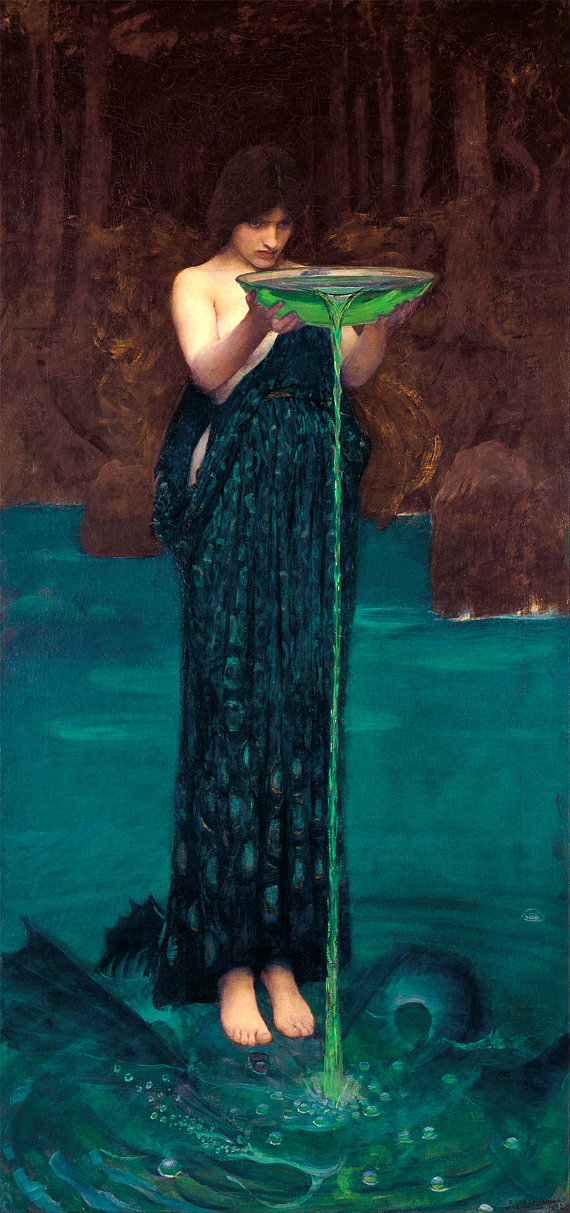
throwing thunderbolts of despair.
Glaucus swims to me, an eel flowing
seal-slick tail and seagrass, hair.

“Give me a cup for love,” he pleads,
“to turn Scylla’s gaze to me.
She is the true pearl my heart needs
in this cold and lonely sea!”

Through the lace-gray fog I find her,
resembling nothing more, than
an ordinary pebble crashed upon
my mind’s sharp and rocky shore.

Her pale eyes must be broken
to miss the breathless beauty in
each curve of every glistening scale–
a divine man clothed in fish’s skin.

What gentle woman would refuse
to embrace such a godly prize–
immortal strength and bold desire infused
with raging powers of the surging tides?

I tell him I will help him,
and in that vow, I do not lie…
The dark magics I brew in my cup
offer gifts of deeper sight.

Smoldering branches, burn deceptions,
baneful leaves and flowers decay.
Fruit of truth—a revelation.
In this cup, the light of day.
 

Be revealed, scuttling cruelty.
Be revealed, heart’s dismay.
Be revealed, false hounds of passion.
With this cup, my will make way. 

Not jealousy, but love’s sacrifice–
a heart cracked pure and cruel
tips the cup into the bath
and poisons Scylla’s pool.

Truth strips the mask of comely skin,
lets loose the spectacle that lies within
the needle teeth, the shrieking bark–
an endless thrash of tentacled arms.

She will screech for all eternity
astride harrowing rocks displayed,
a warning to all unlucky sailors
who dare steer their ships this way.

Published by Alfred Music, 2015, in the score; 
Circe Invidiosa: Sonata No. 1 for the Piano, by Tom Gerou. 
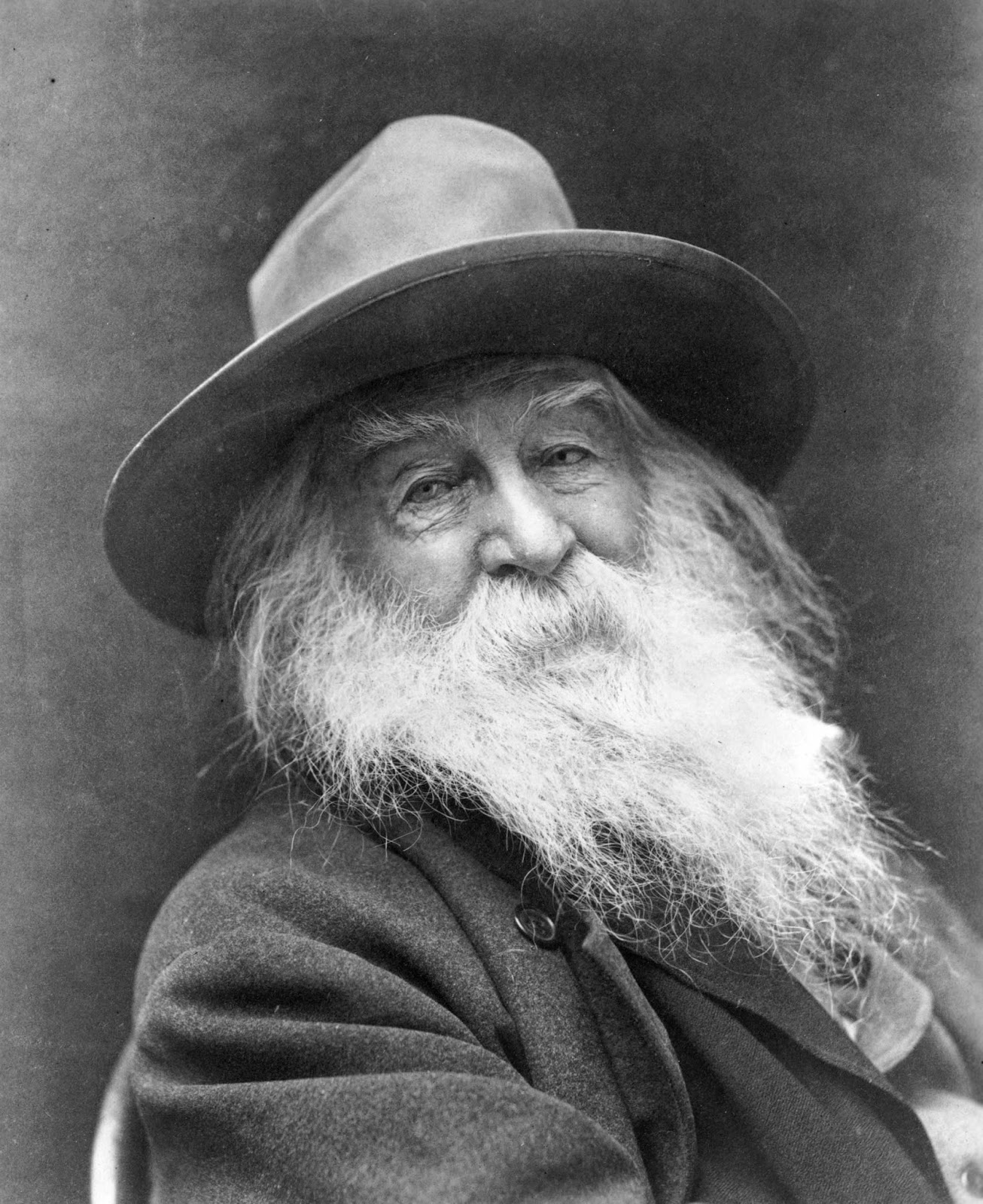
A Found Poem in Honor of Walt Whitman’s Birthday

Walt Whitman

His dress, plain
an exquisite aromawalt whitman
of cleanliness
belonged to his clothes
his breath, his body,
his conversation
his mind, his life,
a purity
physical and moral.

His presence
provoked a state
of exaltation,
like intoxication
by champagne, or
falling in love,
some thought
his mental balance,
impaired.

His way of singing,
an undertone
when alone,
a formless recitative
his intentions simple
and commonplace,
the average man
in average circumstance
grand and heroic.

Strolling, sauntering
outdoors by himself
looking at the grass
the trees, the flowers
vistas of light, varying
aspects of sky, listening
to birds, crickets
tree-frogs, wind
hundreds of sounds.

Writing with pencil
in a loose book
carried in his breast
pocket, a few sheets
of good white paper
folded, and fastened
with a pin, handwriting
clear, every letter
perfectly formed.

Fond of flowers
wild or cultivated,
he wore a bud or
just started rose
perhaps a geranium
pinned to the lapel,
he admired lilacs
and sunflowers
as much as roses.

His touch a charm
that cannot be described,
if it could, would not
be believed, except
by those who knew,
the well and wounded
if understood,
would explain
the mystery of the man.

Others instinctively
disliked him
poetic utterances
so ridiculous,
personal appearance
arousing sarcasm;
large figure, red face
copious beard, loose and free,
met with explosive laughter.

When he said, oh beautiful
sky! oh, beautiful grass!
the words, sweet music,
no alps, Niagara
or Yosemite
is more beautiful than
the ordinary sunset,
earth and sky,
common trees and grass.
 
 
Found poem, based on text from Cosmic Consciousness, by Richard Maurice Bucke, 1901.
You can see the original online at the Internet Sacred Texts Archive.